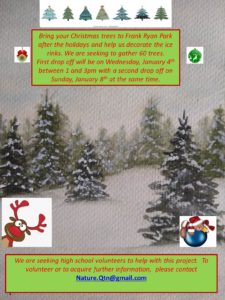
QTNca invites residents to bring their Christmas trees to Frank Ryan Park during specific times after the holidays. The trees enhance our skating rinks and are mulched at the end of the season. See information on poster.

Community Association
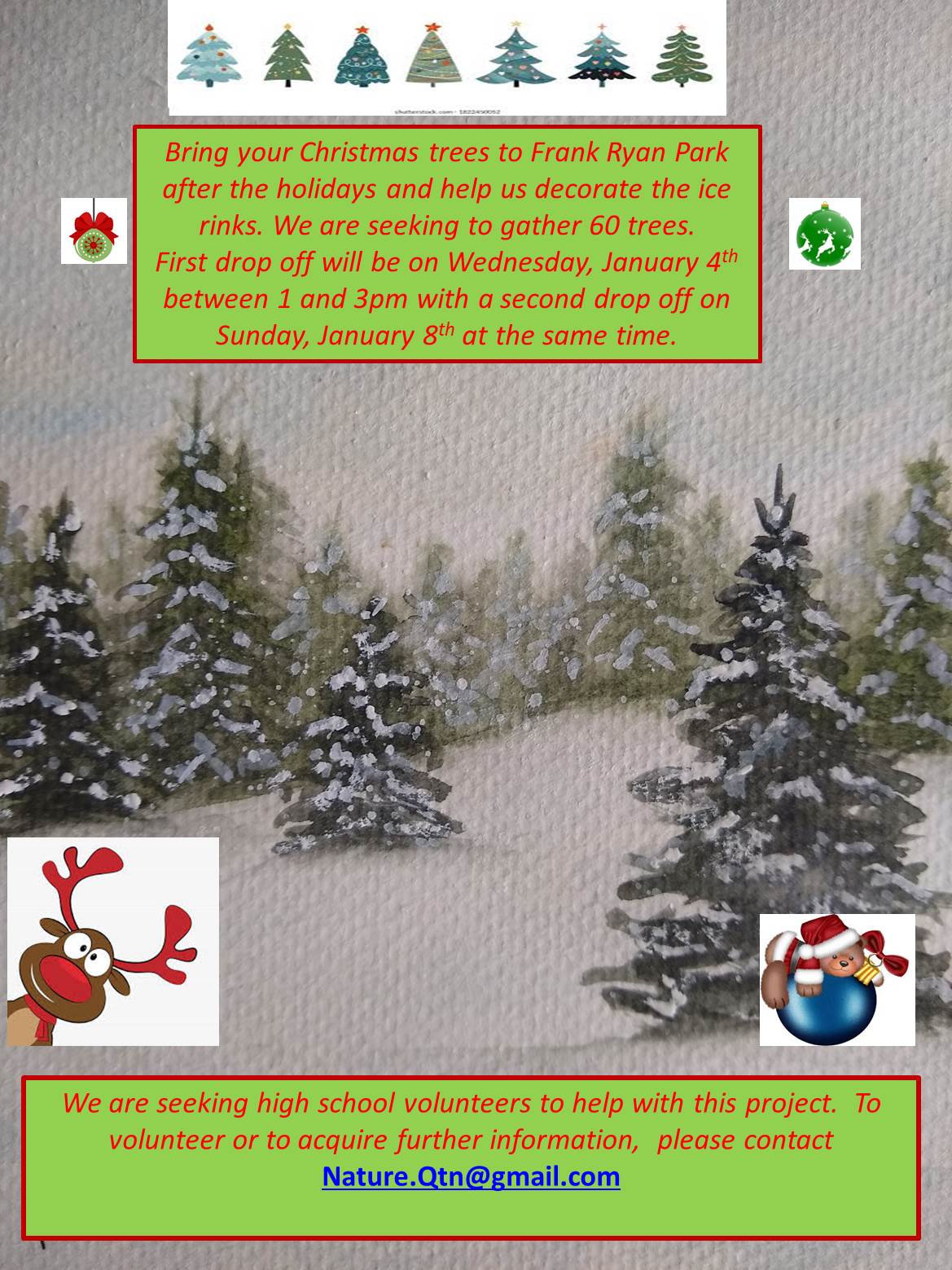
QTNca invites residents to bring their Christmas trees to Frank Ryan Park during specific times after the holidays. The trees enhance our skating rinks and are mulched at the end of the season. See information on poster.
by Caroline Béland-Pelletier, Chair of the QTNca Natural Environment Committee
Caroline has been a QTNca board member for 3 years and has chaired the Natural Environment Committee for two years
From surveys and conversations we know that QTN residents value the green space that we have in our neighborhood. Some report that it was a major factor in their decision to move into QTN. Residents enjoy the parks and forested trails. I also hear praise for our neighborhood’s tree canopy from visitors who come into QTN.
Neighbourhoods with trees and natural areas such as ours promote physical activity which benefits health and well-being. Many of us go for regular walks through QTN. We are fortunate to have natural areas near our doorsteps. It makes us feel good to spend time around trees. Trees are also our ally for climate change adaptation. They moderate temperature, provide shade to help us through the heat waves, provide natural protection against UV rays and can lower the AC bills.
We know we have a good thing in QTN. We cannot take it for granted. The ash borer, one stress factor for our trees, has resulted in the loss of many trees. We’ve also had two seasons of heavy spongy moth infestation, trees dying of old age, and trees and green space being lost in in-fill projects.
QTNca has sponsored projects to help residents minimize the impact of the spongy moth and we have requested tree planting in the forests and parks to replace the trees taken down due to old age or ash borer illness. We advocated for improvements in the tree protection by-law and policies that require green space and soft landscaping surrounding new infill. We promote the inclusion of trees in front-yard spaces in order to maintain a healthy tree canopy throughout QTN. We ran a Canopy Regeneration Project to invite people to plant trees on their properties, to make use of the City tree-in-trust program, and to reach out to us with ideas of where we could add more trees.
For the future, I would like to emphasize that trees and green space have to be an integral part of urban planning. In my opinion, they are the most important part because without nature we are nothing; we won’t exist. It takes a couple of hours to take down a mature tree and all the benefits I mentioned previously. It will take decades to bring that level of canopy back. If, on top of that, we don’t plan for proper green space for trees to grow, we might see a much greyer, asphalt, concrete, plastic-siding looking neighbourhood in decades to come. It is possible to combine redevelopment and greening strategies but it has to be well-planned in advance and not left as an afterthought.
by Lija Bickis, Co-Chair, Safe Streets and Active Transportation Committee.
Lija Bickis. secretary and long-time board member of QTNca, has lead on various sidewalk and traffic safety initiatives for QTNca. She also serves on the community advisory group for the Lincoln Fields Secondary Plan process, along with Kathy Vandergrift.
The neighbourhood is undergoing a significant transformation. In the 10 years that I have been living here, I have watched as the population has shifted to become a neighbourhood with many young families. There are more parents and kids on the street walking, biking, or playing. The increase in families is related to the increase in the number of dwellings, as older bungalows have been replaced with semi-detached units.
It is difficult to split discussion of intensification between housing and transportation impacts. I will talk about the streets. And I say streets on purpose, as QTN has very few sidewalks. At the time our neighbourhood was laid out, cars were fewer in number and also smaller and slower. Walking or rolling in QTN can be stressful, as most streets have no delineation between parking/driving/active users. Moving around with kids can be extra stressful, as they are unpredictable. Drivers can also be unpredictable – anyone in QTN will know the effects of swerving for a squirrel!
City budgets for sidewalks in neighborhoods dealing with in-fill are very far below the demand – essentially a neighborhood can get one if it is attached to another project (sewer rehab, LRT, etc). In a recent example of advocacy from QTNCA, a board member noticed a house for sale in the approximate area that the City had targeted for a pathway to Queensview station. With some quick work from our councillor and city staff, the property was acquired for the future connection. However, there won’t be a sidewalk between Severn school and the pathway, as that one house-long piece of sidewalk isn’t in anyone’s budget. As in many things related to transportation in Ottawa, the work is piecemeal.
As another example, the new, 30 km/h zone speed limits are one area where the City has made steps to improve safety, but they only deliver signs – there is no official enforcement, nor a significant increase in the traffic calming budget. Councillors have a relatively small budget to use for requests from across the ward.
Beyond the issues on QTN streets, there is the bigger picture question of travel across the city. Getting in and out of QTN can be a challenge, with the barriers of the transitway and the Queensway. Turning left out of QTN onto Pinecrest is difficult during much of the day, and there are large stretches without safe crossings for people who walk or roll. Carling also has significant barriers to the flow of people in and out of our neighbourhood, with only two signalized intersections to cross. QTN residents who walk or roll are lucky to be close to the NCC’s pathway network, but that lacks connections to local destinations such as the Lincoln Fields Metro, or the Carlingwood library. And the key pedestrian connection between QTN and Whitehaven has been demolished with a very inadequate plan for replacing it, forcing hundreds of students to detour up to Carling Avenue.
As QTNCA, ‘getting around’ is one of our key issues for the neighbourhood. There is a lot of room for the City to make improvements for everyone in QTN, regardless of the mode(s) we use to get around.